For U.S. healthcare professionals only
 Takeda is committed to advancing care and providing continued support for the hemophilia A community.
See how
For U.S. healthcare professionals only
Takeda is committed to advancing care and providing continued support for the hemophilia A community.
See how
For U.S. healthcare professionals only
Takeda is committed to advancing care and providing continued support for the hemophilia A community.
See how
For U.S. healthcare professionals only
Takeda is committed to advancing care and providing continued support for the hemophilia A community.
See how
For U.S. healthcare professionals only
Indications and Limitation of Use: ADYNOVATE is indicated for use in adult and pediatric patients with hemophilia A (congenital factor VIII deficiency) for on-demand treatment and control of bleeding episodes, perioperative management, and routine prophylaxis to reduce the frequency of bleeding episodes. ADYNOVATE is not indicated for the treatment of von Willebrand disease.1
A prospective global registry* tracking newly diagnosed hemophilia A patients (N=1038) found8:
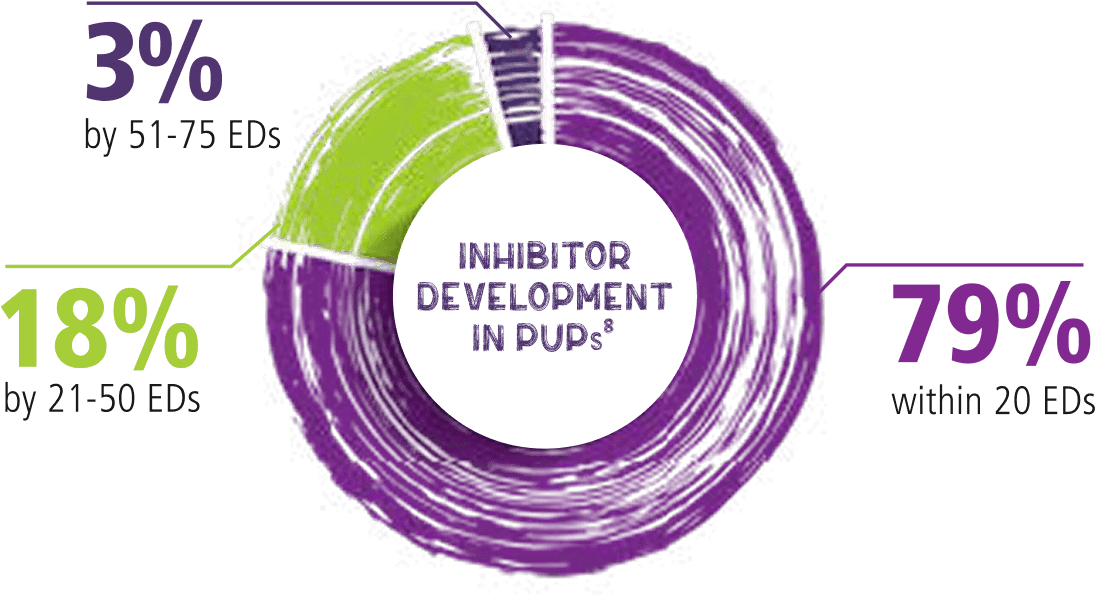
*Aiming to define the risk periods for inhibitor development until 1000 EDs.8
ED=exposure day.
A low inhibitor development rate of 11% was observed in the ADYNOVATE PUP Study1
From the completed study in 120 PUPs with severe hemophilia A

patients were evaluable for inhibitor development1*

patients developed FVIII inhibitors associated with ADYNOVATE treatment
After mean (SD) exposure days of 7.6 (4)1

patients did not develop FVIII inhibitors1
*The remaining 20 patients had <100 EDs when they discontinued or completed the analysis and therefore were not included in the evaluation.13
Of the 11 patients who developed FVIII inhibitors, 6 developed high-titer inhibitors (>5 Bethesda Units), and 5 developed low-titer inhibitors (≤5 Bethesda Units).1
Formation of neutralizing antibodies (inhibitors) to FVIII can occur following administration of ADYNOVATE. Monitor patients regularly for the development of FVIII inhibitors by appropriate clinical observations and laboratory tests.1
STUDY DESCRIPTION
STUDY OBJECTIVE
ELISA=enzyme-linked immunosorbent assay; IgG=immunoglobulin G;
IgM=immunoglobulin M; SD=standard deviation.


Hypothetical patient
Individual results may vary.
Noah, 3 years old
My child’s hemophilia A story
Treatment considerations from Noah’s HCP
Why did Noah’s HCP choose ADYNOVATE?
Formation of neutralizing antibodies (inhibitors) to FVIII can occur following administration of ADYNOVATE. Monitor patients regularly for the development of FVIII inhibitors by appropriate clinical observations and laboratory tests.1


Takeda has a variety of resources to help you and your patients navigate access to ADYNOVATE.
See the resources
ADYNOVATE has a twice-weekly dosing regimen that you can tailor to each patient.1
See How
 IMPORTANT RISK INFORMATION
 SEE MORE
CONTRAINDICATIONS: ADYNOVATE is contraindicated in patients who have had prior anaphylactic reaction to ADYNOVATE, to the parent molecule (ADVATE [Antihemophilic Factor (Recombinant)]), mouse or hamster protein, or excipients of ADYNOVATE (e.g. Tris, mannitol, trehalose, glutathione, and/or polysorbate 80).







You are being directed to ADYNOVATEPro.com. The information
on this website is intended for U.S. healthcare professionals only.